
Is My Child Ready to Read? Here's How to Tell
Most parents wonder this somewhere between three and a half and five and a half. Here are the real signs, the false alarms, and a free way to check today, with zero pressure either way.
Word Safari's English content and placement begin around age 4. If your child is a little younger and still playing with sounds, that is exactly the right groundwork, not a reason to wait for a magic birthday.
The question almost every parent asks
There is no single age when a switch flips and every child is suddenly ready. Some three year olds are already playing with sounds; some five year olds are still finding their feet, and both are completely normal.
What actually matters is a small set of skills clicking into place, not a birthday. Word Safari's placement is built around exactly that: it finds where your child sits today, not where a chart says they should be.
Signs your child is leaning in
None of these need to show up all at once. Two or three together are usually a good sign it is worth a try.
- Playing with sounds. Rhyming games, clapping out syllables, or noticing that "cat" and "hat" sound alike.
- Noticing letters. Pointing out a letter from their name on a sign or a cereal box, and asking what it says.
- Sitting through a whole story. Following a picture book from start to finish without losing interest.
- Pretend reading. Holding a book the right way up and "reading" the pictures aloud, even from memory.
What not to worry about
A few things trip parents up that genuinely are not red flags:
- Not knowing every letter yet. Sound comes before the alphabet in Word Safari's own ladder, not after it.
- An off day. Attention for a five year old is not a straight line; a distracted afternoon says nothing about readiness.
- Comparing to a sibling or a classmate. Every child's ladder starts at a different rung, which is the whole point of a placement rather than a fixed starting line.
What if they're not quite there yet?
Nothing is lost by waiting a little longer. Rhyming, singing, and story time at home are already doing the groundwork, and Word Safari's earliest stage, aligned to Cambridge Early Years, is built for exactly this point on the ladder. See our Cambridge Early Years practice page for what that looks like before a single letter sound has clicked.
The quickest way to actually find out
Reading a checklist only gets you so far. The fastest honest answer comes from watching your child actually try.
Word Safari's placement takes roughly five minutes, plays like an ordinary round rather than a test, and always ends on a win regardless of where your child lands. It is free, with no trial clock and no card needed, and every round after keeps adjusting as your child plays, so a first guess is never a life sentence. Read more on our free reading placement test page.
What a first round looks like
At the very start of the ladder, a round is simple on purpose: matching a sound to a letter, matching a picture to a word, listening and repeating. Nothing assumes your child has read a word before today.
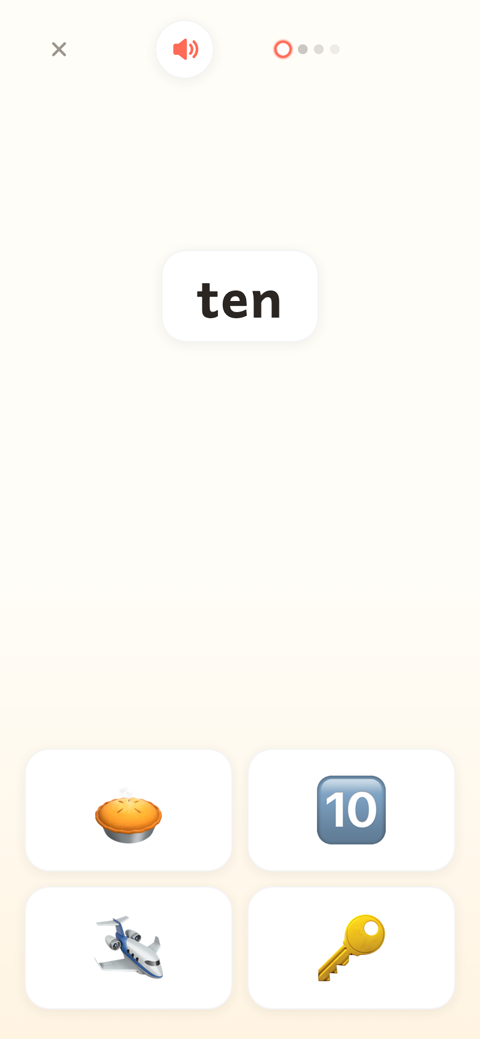
English content runs ages 4 to 11 across 7 phonics tiers, and this is the very beginning of that ladder. See our reading app for 4-5 year olds for what comes right after this first round.
What's waiting once they start
From single letters through digraphs and trigraphs, taught sound first.
Hand-curated across 7 phonics tiers, so there is always a next step.
Up to six children on one account, each with their own level and progress.
Introduced gradually, starting with the simplest matching rounds.
See where a short placement leads
Sign up free and let a five-minute placement answer the question better than any checklist can.
Prefer to see it first? Try a round on the homepage demo →
No ads, offline, and private by default
Questions parents ask
Is there a minimum age to start?
Word Safari's English content and placement begin around age 4. For a slightly younger child, sound play and story time at home are the best groundwork, and there is no harm in waiting a little longer.
What if my child does not know all their letters yet?
That is completely normal and will not hold them back. Placement starts among the earliest of 73 letter sounds, not assuming your child already knows the alphabet.
Is it bad to start too early or wait too long?
Neither is a mistake. The placement is a starting estimate, not a verdict, and it keeps adjusting as your child plays, so an early start or a later one both settle into the right level naturally.
How do I actually find out where my child stands?
A short, playful placement round, roughly five minutes, finds a real starting point today. It is free, needs no card, and always ends on a win.